
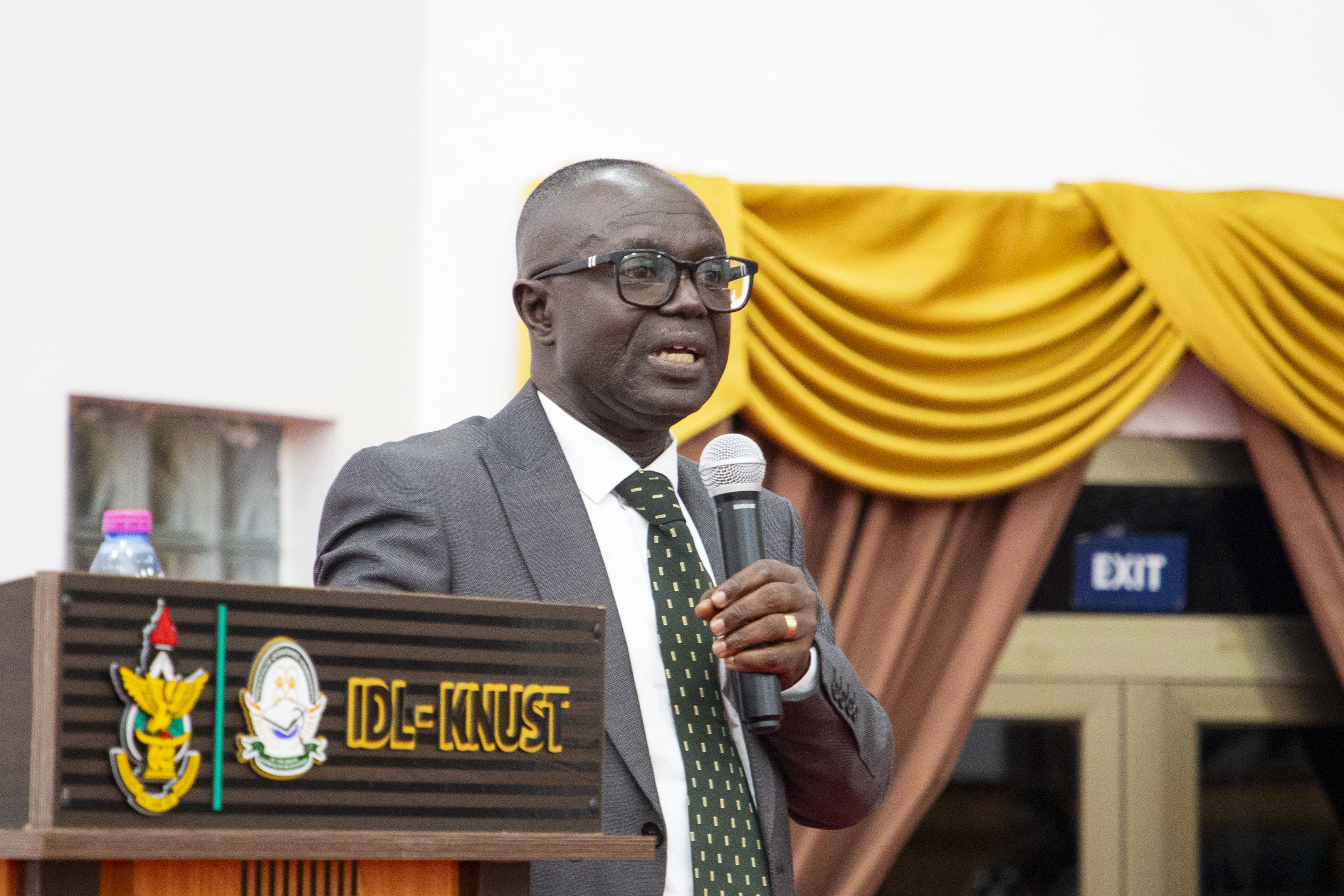
Respectful working relationships and a willingness to learn from colleagues are essential to effective university administration, says Mr Owusu-Ansah Debrah, whose more than 25 years at the Kwame Nkrumah University of Science and Technology, Kumasi (KNUST) have involved managing examinations, supporting institutional change and contributing to policy.
“Wherever that you go, please make friends,” the retiring Deputy Registrar advised younger administrators at the maiden exit seminar organised by the Registrar’s Office.
Held on October 29, 2026, the seminar brought Mr. Debrah and fellow outgoing Deputy Registrar Mr Anthony Adjapong together with serving and retired administrators to discuss the responsibilities, challenges and lessons of university service.
Relationships and continuous learning
Mr. Debrah encouraged administrators to cultivate productive relationships across university offices and use persuasion when working with academic colleagues and navigating institutional processes.
Drawing on his early experiences, he stressed the importance of hard work, learning from experienced colleagues and treating people with respect. He highlighted these qualities particularly in managing teams whose members had different levels of experience and seniority.
His reflections drew on assignments across the College of Engineering, the University Examinations Office, the Registrar’s Office, the College of Agriculture and Natural Resources, the College of Art and Built Environment and the Institute of Distance Learning.
The interaction also allowed participants to seek advice on difficult workplace relationships, balancing professional responsibilities with personal commitments and strengthening mentorship for younger staff.
Policy reform and institutional change
Mr. Debrah’s work has included participation in committees that helped shape university policy, including the first edition of the Rules and Regulations for the Conduct of University Examination in 2006 and the Criteria for the Appointment and Promotion of Senior Members in the administrative and professional categories.
At the then College of Architecture and Planning, he provided administrative support to the team that managed the incorporation of the Faculty of Art to form the College of Art and Built Environment.
His written contributions also addressed how the university organises administrative work, makes appointments and distributes responsibilities.
Two papers listed for 2016 were “Representation on Boards where Rank is the Primary Qualification” and “Decentralisation of Promotion from Lecturer to Senior and Analogous Grades to the College: The Experience of CABE”.
His 2017 paper, “Towards the Strengthening of the Administrative Unit of the University: The Case of the Dean of Students’ Office”, considered another part of the university’s administrative structure.
Preparing recommendations is also part of his responsibilities at the Institute of Distance Learning. These include conducting studies, identifying gaps and writing memos, position papers and concept papers proposing improvements within the Institute and the wider university.
Admissions examinations and academic support
Mr. Debrah’s experience in examination administration began with his transfer to the University Examinations Office in January 2005. He coordinated the conduct of examinations and the preparation of certificates for successful graduates.
His October 2010 paper, “The Two-Tier System and the Consideration of Examinations Results”, addressed the handling of examination results.
Admissions featured in his 2018 work with K. A. Karikari and Paul K. Addo, “Consideration of General Agriculture Students in Senior High School for Admission in BSc Agriculture and Natural Resources programmes”.
At the Institute of Distance Learning, his responsibilities include liaising with institute, college and faculty examination officers to support the smooth conduct of examinations.
He also interprets university regulations concerning students and staff and supports suitable conditions for teaching and learning, including environmental cleanliness and the provision of adequate facilities.
Industry collaboration and leadership research
Mr. Debrah’s listed papers extend to the university’s relationships with industry and the practice of leadership in higher education.
In March 2011, he produced “Proposal for Industry Support and Collaboration with College of Architecture and Planning”.
He and Dr. Paul Kwadwo Addo co-authored “Examination of Influence of Cultural Leadership practices for 21st Century Universities: The Ghana Perspectives”. The paper was presented at the Association of Caribbean Higher Education Administrators conference from July 11 to 13, 2019.
Together with his work on admissions, examinations, board representation, promotion and administrative structures, these papers show the range of institutional questions addressed in his written contributions.
Managing people and implementing policy
As Registrar of the Institute of Distance Learning, Mr. Debrah’s work covers general administration, academic and student affairs, human resource management, legal and welfare matters, and university relations.
He serves as Secretary to the Institute’s Board and a member of its Management Committee, while supporting other committees established by the Institute. He advises the Director on day-to-day administration and management.
His responsibilities include policy development, implementation, monitoring and evaluation within university-wide guidelines, as well as interpreting statutes, policies and regulations.
He directly supervises staff in the Institute’s offices and has oversight responsibility for staff other than academic senior members. He also advises appointments and promotions committees on the policy guidelines governing their work.
Professional representation and community service
Mr. Debrah served as Vice-President of the KNUST branch of the Ghana Association of University Administrators from 2008 to 2012. He was part of the team that successfully negotiated members’ migration to the Single Spine Salary Structure.
He belongs to the Ghana Association of University Administrators, the Ghana Bar Association and Lions Clubs International.
A Protestant Christian and member of the Presbyterian Church of Ghana, Debrah served as Assistant Secretary of the Asante Presbytery Choirs’ Union from 2007 to 2009. The union’s membership included about 2,000 adults and 200 minors.
He subsequently served as the union’s President from 2010 to 2016. He has also held several positions in the Garden City Lions Club in Kumasi, including President for the 2015/2016 service year.
Outside his professional and community responsibilities, Debrah enjoys listening to music, particularly hymns and choral music. He also likes indoor games, with Scrabble his favourite. He is married to Radeska and has a child and two grandchildren.
Career development and institutional continuity
Mr. Debrah joined KNUST in May 2001 following his appointment by the University’s Governing Council. His first posting was to the then School of Engineering, the precursor to the College of Engineering, where he was responsible for administration under the Dean.
After his January 2005 move to the University Examinations Office, he transferred to the Registrar’s Office in November 2006 and to the then College of Architecture and Planning in August 2009. His subsequent service included the College of Agriculture and Natural Resources and the Institute of Distance Learning.
He rose to Senior Assistant Registrar in October 2008, became Acting Deputy Registrar in August 2009 and was promoted to Deputy Registrar in 2016.
The Registrar, Mr Benjamin Boampong Owusu, said the exit seminar offered an opportunity to preserve the outgoing officers’ professional knowledge for younger administrators. He described the engagement as supporting mentorship, succession planning and professional development to improve administrative practice and service delivery.
“We recognize and appreciate their contribution to university administration and policy implementation,” he said.
For Mr. Debrah, the advice he offered younger colleagues centred on learning from others and maintaining the relationships that enable cooperation across the university. The Registrar said sharing such experience could help the institution retain knowledge beyond the officers’ retirement.
“By sharing knowledge and creating opportunities for younger officers to learn from experienced colleagues, we can strengthen institutional continuity and improve administrative practices and service delivery,” Mr Owusu said.
Story: Abigail Ofori & Emmanuel Kwasi Debrah Photos: Alex Tovor Tamakloe


